Semantic Survey Methodology: Difference between revisions
mNo edit summary |
mNo edit summary |
||
| Line 6: | Line 6: | ||
==ToDo== | ==ToDo== | ||
* select a narrow research field with many comparable approaches as an example - e.g. link discovery, named entity recognition, relationship extraction, | * select a narrow research field with many comparable approaches as an example - e.g. question answering, link discovery, named entity recognition, relationship extraction, | ||
* select 10-20 papers in this field | * select 10-20 papers in this field | ||
* create pages for all papers in OpenResearch comprising key semantic information about the work described in the paper: | * create pages for all papers in OpenResearch comprising key semantic information about the work described in the paper: | ||
| Line 15: | Line 15: | ||
*** implementation - programming language, | *** implementation - programming language, | ||
*** evaluation - dataset, precision, recall, performance | *** evaluation - dataset, precision, recall, performance | ||
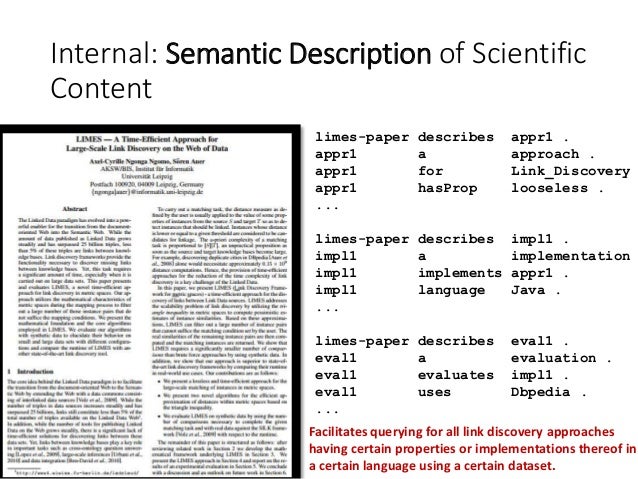
** See slide 13 in http://www.slideshare.net/soeren1611/towards-digitizing-scholarly-communication http://image.slidesharecdn.com/towardsdigitizingscholarlycommunication-160818165519/95/towards-digitizing-scholarly-communication-13-638.jpg?cb=1471539491 | |||
See slide 13 in http://www.slideshare.net/soeren1611/towards-digitizing-scholarly-communication | * create queries or faceted browsing interface for browsing/exploring the approaches | ||
http://image.slidesharecdn.com/towardsdigitizingscholarlycommunication-160818165519/95/towards-digitizing-scholarly-communication-13-638.jpg?cb=1471539491 | |||
Revision as of 22:56, 9 November 2016
Despite significant advances in technology, the way how research is done and especially communicated has not changed much. We have the vision, that ultimately researchers will work on a common knowledge base comprising comprehensive descriptions of their research, thus making research contributions transparent and comparable. In this article, we describe how surveys on research fields can be performed in a semantic way resulting in a knowledge graph describing the individual research problems, approaches, implementations and evaluations in a structured, comparable way. We illustrate our methodology with the example of ...
ToDo
- select a narrow research field with many comparable approaches as an example - e.g. question answering, link discovery, named entity recognition, relationship extraction,
- select 10-20 papers in this field
- create pages for all papers in OpenResearch comprising key semantic information about the work described in the paper:
- bibliographic data: title, abstract, authors, publication venues
- semantic descriptions of the
- problem,
- approach - characteristics (lossless/fuzzy, ...),
- implementation - programming language,
- evaluation - dataset, precision, recall, performance
- See slide 13 in http://www.slideshare.net/soeren1611/towards-digitizing-scholarly-communication http://image.slidesharecdn.com/towardsdigitizingscholarlycommunication-160818165519/95/towards-digitizing-scholarly-communication-13-638.jpg?cb=1471539491
- create queries or faceted browsing interface for browsing/exploring the approaches